If your Google Business Profile is where customers meet you first, your Services menu is the opener that either gets a nod or gets ignored. The right structure, names, and prices can trigger those delicious little map justifications like “Provides: Emergency AC Repair” or “Their website mentions crown molding,” help you appear in filters, and send people straight to a call or booking. This guide shows you how to build a service menu that surfaces more, sells faster, and can be tracked to real revenue with simple, reliable booking conversion tracking.
Why Your GBP Services Matter
When someone searches locally, the Map Pack does not just list names and reviews. It decorates results with justifications that answer the searcher’s silent questions. “Do they do this exact job? How much is it? Can I see proof? Is it fast?” The Services section in your Google Business Profile feeds those justifications with language that matches what people type and what Google can parse. If your Services are vague, missing prices, or misaligned with your website, you reduce the chance of a justification and you lower click intent. If your Services match real-world search terms, link to real pages, and use clear pricing, you get more map visibility and more ready-to-book clicks.
Services vs Products
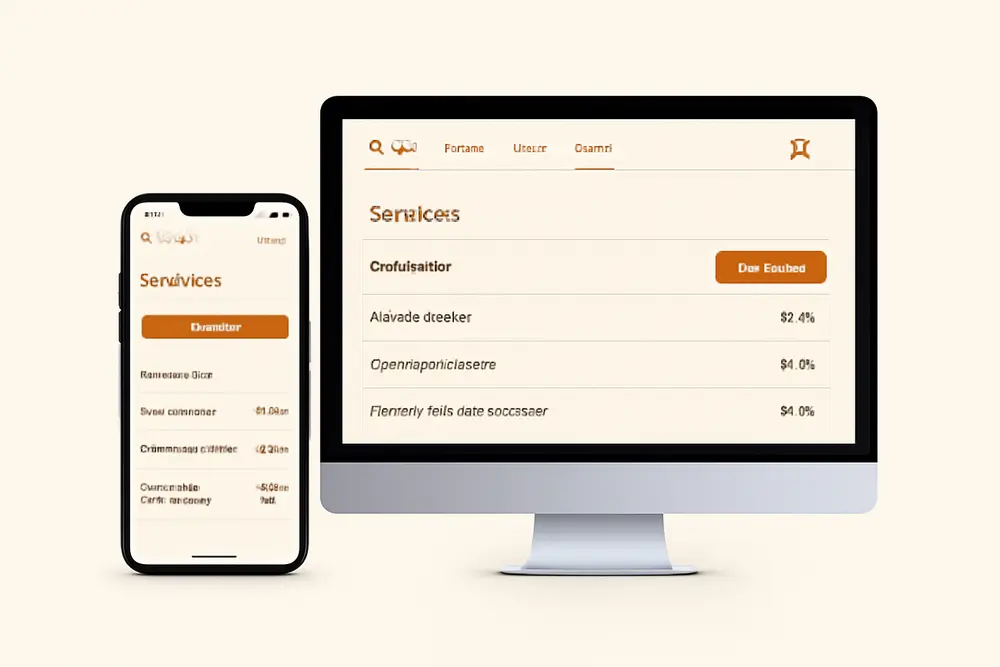
The Services section is your full menu. List every job you actually sell: core services, variations, add-ons, and common bundles. Use plain service and trade terminology. The Products section is your featured shelf. It is visual, includes images and prices, and is often more click-worthy for high-demand offers. Many local businesses win by listing the broad set in Services, then spotlighting the few offers that should get 80 percent of clicks in Products with photo, scoped description, and a tracked button to book or learn more.
Example split that works:
HVAC company:
- Services: AC repair, furnace repair, heat pump install, tune ups, thermostat replacement, duct sealing, indoor air quality testing
- Products: Emergency AC repair – 90-minute arrival window, Seasonal tune up – 18-point checklist, Mini split install – 1 to 2 zones
Service Menu Optimization
Service menu optimization starts with search intent. People do not search for “Premium Package A” or “Silver Plan.” They search for “same day drain cleaning,” “crown molding install,” “Botox 30 units,” “roof leak repair near me,” and “mobile brake pad replacement.” Your menu should talk like your buyers and include the qualifiers that matter to them: timeframe, location, scope, and style. That language can unlock “Provides” justifications in the Map Pack and better alignment with filters.
Use categories inside Services to keep the list skimmable. Categories are not always visible to users, but they help you organize and push relevance signals to Google. Group by buyer logic: “Emergency Repairs,” “Seasonal Maintenance,” “Installations,” “Cosmetic Upgrades,” or by room or system for contractors and remodelers.
Then write names that do the heavy lifting. A strong name stands on its own in the Map Pack without the description. If your title reads “Standard Package,” nobody knows what that means. If it reads “Drain Cleaning – Hydro Jetting,” you are in the game.
| Generic | Better | Best |
|---|---|---|
| AC Service | AC Repair | Emergency AC Repair – 90 Minute Arrival |
| Dental Cleaning | Teeth Cleaning | Adult Teeth Cleaning – 60 Minutes |
| Landscaping | Lawn Mowing | Lawn Mowing – Weekly or Biweekly |
| Roofing | Roof Leak Repair | Roof Leak Repair – Asphalt Shingle |
| Home Painting | Interior Painting | Interior Painting – 1 Room up to 200 sq ft |
Notice the pattern. “Best” versions add a key qualifier that matches how people decide: speed, duration, frequency, or scope. Those same qualifiers are perfect for map filters like “Open now” or for satisfying intent around urgency. Keep names under 60 characters where possible so they do not truncate, and avoid clever labels that hide the point. Clarity wins.
Pricing That Builds Trust
Pricing in GBP is not just a number. It is a trust signal. If your actual cost varies because of size, materials, or units, use ranges or “starting at” along with a short note on what changes the price. Keep it consistent with your website prices or ranges. Inconsistencies reduce trust and can lower conversions.
Examples you can borrow and adapt:
Plumbing:
- Drain Cleaning – Hydro Jetting: $249 weekdays, $299 weekends
- Toilet Replacement – Standard Height: Starting at $389 parts not included
Med spa:
- Botox – 30 Units: $369 average results 3 to 4 months
- Lip Filler – 1 Syringe: $599 includes numbing
Contractor:
- Crown Molding Install – Per Room: $7 to $12 per linear foot materials separate
- Kitchen Backsplash – Subway Tile: Starting at $899 includes grout and seal
Two rules keep you out of trouble. Do not post a price your team cannot honor, and do not bury the cost in “call for quote” unless it is truly custom. Even a useful range beats a mystery. Then make sure the price in GBP matches the linked page price. Mismatches are a conversion killer.
Triggering Map Justifications
You can influence the justifications that appear under your listing by aligning the language across Services, Products, your website, reviews, Q&A, and Posts. Here is how each one helps:
Services: Exact service names can trigger the “Provides” label in Maps. If your service is “Emergency AC Repair – 90 Minute Arrival,” you can earn a “Provides: Emergency AC Repair” justification for relevant searches. Use the description to repeat the core phrase and include qualifiers like neighborhoods, timelines, and what is included.
Website: On the landing pages you link from GBP, use the same service names and include the phrase in the H1 and early in the copy. Google sometimes shows “Their website mentions [service]” when it sees strong alignment. If you serve distinct neighborhoods, include a city or area reference on the page in a natural way, then match that in the GBP description or Products caption.
Reviews: Reviews that mention the exact service are gold. After a successful job, prompt customers with a nudge like “If you can, mention ‘drain cleaning’ so neighbors with the same issue can find us.” Do not script reviews, just ask honestly. These can trigger “People often mention” justifications.
Q&A: Seed the Q&A section with real questions and answers that echo your services. Example: “Do you offer same day water heater installs?” Then answer with your exact phrasing and link to the service page with a tracked URL. For a framework on turning Q&A into click-to-call funnels, see this playbook from Replock Marketing.
Posts: Use Posts to feature seasonal or urgent services. Repeat your service name, add a photo, and link with tracking to the same landing page you used in Products. Posts can feed justifications and give you more touchpoints in your Profile.
Visuals That Sell
Photos in Products and Services are converters. People want to see the work, the crew, and outcomes. Use before and after shots for trades, clear packaging photos for retail-like services, and team images for providers where trust matters. Avoid generic stock photos. Tie each visual to a service with a caption that mirrors your service name and price. If you feature “Mini Split Install – 1 to 2 Zones,” include a photo of a recent install with a short caption that repeats the name and notes timeframe, like “Installed in a single day.” Consistent visuals also increase the chance your Service or Product stands out in the GBP carousel.
Tracking That Proves ROI
Conversion tracking from GBP is easier than it looks. Every tap or click from your Profile to your site should carry UTM parameters so GA4 and your CRM can attribute the lead. Your targets are booked appointments, confirmed calls, and form submissions.
Link structure for Products and Services buttons:
Base URL of your landing page plus:
?utm_source=google&utm_medium=organic&utm_campaign=gbp&utm_content=service_drain_cleaning
Change the utm_content value to the exact service or product slug. Examples:
- utm_content=service_emergency_ac_repair
- utm_content=product_seasonal_tune_up
- utm_content=service_bathroom_remodel
In GA4, set up conversion events for:
- book_appointment fired on booking confirmation page or booking success event
- call_click fired when a user taps a tel: link
- lead_form_submitted fired on thank you page for lead forms
- direction_click fired on click of the Directions button if you route it through your site, otherwise use GBP insights for directions
Report by Session source or First user source equals google, Medium equals organic, Campaign equals gbp, then break down by utm_content to see which Service or Product pulled the lead.
Phone tracking without hurting NAP consistency:
Leave your primary business number in the main phone field in GBP. If call tracking is allowed in your country, add your tracking number as an additional phone number. If you run third-party call tracking on your website, use dynamic number insertion that swaps the number only on your site based on UTM parameters. You get attribution while keeping your core NAP consistent across the web.
Match GBP To Your Site
Your GBP and your website should look like they were written by the same person on the same day. That means service names, descriptions, pricing, FAQs, and photos all line up. Create or update a landing page for each service you feature as a Product and for any high-intent Services. Use the identical names and prices on both. Copy your short GBP description into the page in a fuller form with details on what is included, how long it takes, warranties, and next steps.
Give each page an FAQ section that matches buyer objections and terms searchers use. Mark it up with FAQ schema so Google can connect dots between queries, your site, and your GBP. Example questions might include “How fast can you arrive for emergency AC repair?” or “What is included in an 18-point tune up?” Keep your answers short, scannable, and honest. When these match your GBP Q&A and Services copy, you stack relevance signals.
Finally, keep your buttons consistent: “Book Online,” “Call Now,” or “Get Estimate.” Use the same phrasing on your GBP Products, Services, and on-site CTAs to reduce friction.
Pitfalls To Skip
There are patterns that quietly cost leads. Avoid these:
Inconsistent pricing: If you post $249 on GBP and $299 on your page, buyers notice. They leave. Update both places on the same day when prices change.
Vague service names: “Premium Package” or “Gold Plan” tells nobody what you do. Use plain terms that align with real searches.
Too many Products: Listing 30 Products turns your Profile into a rummage sale. Feature 3 to 8 offers that match your growth goals and seasonal demand. Put the full list in Services.
Stock photos: Shiny but hollow. Show your real work. People can tell.
Missing tracking: Links without UTMs break attribution. You will not know what is driving calls or bookings. Fix this first.
Ignoring seasonality: Rotate featured Products and update Services for seasonal terms. “Furnace tune up” beats “HVAC service” in October. “AC tune up” wins in May.
Policy blind spots: Keep your business name clean of keywords, and avoid misleading claims in Services. Match your real-world offering and service area. When in doubt, follow Google’s guidelines.
Quick Wins And Templates
If you want traction this week, use these shortcuts.
Update your top 5 Services with buyer language and qualifiers. Examples to copy and customize:
- Drain Cleaning – Hydro Jetting – Starts at $249
- Emergency AC Repair – 90 Minute Arrival – From $149 diagnostic
- Teeth Whitening – 90 Minutes In Office – $199 special
- Lawn Mowing – Weekly or Biweekly – From $39 per visit
- Interior Painting – 1 Room up to 200 sq ft – From $399
Create 3 featured Products with photos and tracked links. Try one urgent, one seasonal, one high-margin:
Urgent: “Water Heater Replacement – Same Day Available – From $1,199” link to /water-heater-replacement plus UTMs.
Seasonal: “Furnace Tune Up – 18 Point – $89” link to /furnace-tune-up plus UTMs.
High margin: “Mini Split Install – 1 to 2 Zones – Free Estimate” link to /mini-split-install plus UTMs.
UTM template to standardize with your team:
?utm_source=google&utm_medium=organic&utm_campaign=gbp&utm_content=service_[service-slug]
Replace [service-slug] with a short snake case label like service_drain_cleaning or product_furnace_tune_up.
Monthly housekeeping checklist:
- Rotate seasonal offers in Products and update any prices that changed
- Add 2 new photos tied to Services or Products with helpful captions
- Seed 1 Q&A that answers a buyer question with a tracked link
- Review GA4 for sessions where Campaign equals gbp and log which utm_content drove conversions
- Pull 2 new review requests that mention the exact service name
GBP Services FAQ
Here are common questions we hear when teams start tuning their GBP menus for conversions and map visibility.
Should I List Every Service Variation Or Just The Big Ones?
List the full menu in Services. Variations and add-ons help you match long tail searches and earn “Provides” justifications. In Products, only feature the services that drive the most calls or bookings or that you want to push seasonally.
Can I Include Neighborhood Or City Names In My Service Names?
Yes, in Services and descriptions, if it reflects where you truly operate. Example: “Drain Cleaning – North Hills.” Do not add city names to your business name. Keep location mentions natural and consistent with your service area pages on your site.
What If My Pricing Always Requires A Quote?
Use “starting at” or ranges with a concrete promise. Example: “Bathroom Remodel – Starting at $12,000 – Free in-home quote.” Then describe what affects cost in the description. This is better than “call for price,” which feels like a dead end.
How Do I Track Phone Calls From GBP Without Messing Up My NAP?
Keep your main number as the primary phone in GBP. Where available, add the tracking number as an additional number. On your website, use dynamic number insertion that swaps numbers based on UTMs. If your region supports it, enable GBP call history for extra reporting.
How Often Should I Update My Services And Products?
Quarterly at minimum, monthly during peak seasons. Update prices, rotate seasonal offers, and refresh photos. Any time your site updates a price or scope, update GBP the same day.
What Triggers The “Provides” Justification?
Exact or very close matches in your GBP Services names and sometimes descriptions. Consistency with your website and reinforcement in reviews, Posts, and Q&A can help. Keep names plain and aligned with real searches.
Is It Worth Adding Photos To Each Product Or Service?
Yes. Images increase clicks. Use real photos tied to the offer and caption them with service name and a key qualifier like timeframe or scope. Avoid repeating the same image across every item.
How Do I Know If Products Or Services Are Driving Bookings?
Use UTMs on every link and set GA4 conversion events for book_appointment, call_click, and lead_form_submitted. Filter reports for Campaign equals gbp and check which utm_content values close the most. Pair that with call logs and booking reports in your CRM.
Can I Reuse My Website Copy In GBP?
Yes, and you should. Align names, prices, and short descriptions. Do not paste walls of text. Keep GBP descriptions short, clear, and scannable, then send people to the matching page for full details.